

Name the immediate task, ask for a specific action and confirm the handoff without assuming the other adult has understood. Discuss recurring workload problems later, when both of you can focus on the conversation.
Ask for one clear action and make responsibility explicit before moving on.
Hi, I’m Ms. Jenn, a preschool teacher with 20 years of experience. I currently teach in a two year old classroom and share practical ideas from everyday teacher life here at Coffee and Circle Time.
Make the request concrete
Instead of saying you need help with everything, name the action that would make the next minute manageable. For example, ask whether your partner can supervise a defined group while you complete another required task.
Use the role names and supervision procedures your program expects. A request should not create uncertainty about who is responsible for children.
If the situation is urgent, follow your setting’s support procedure rather than waiting for a convenient conversational moment.
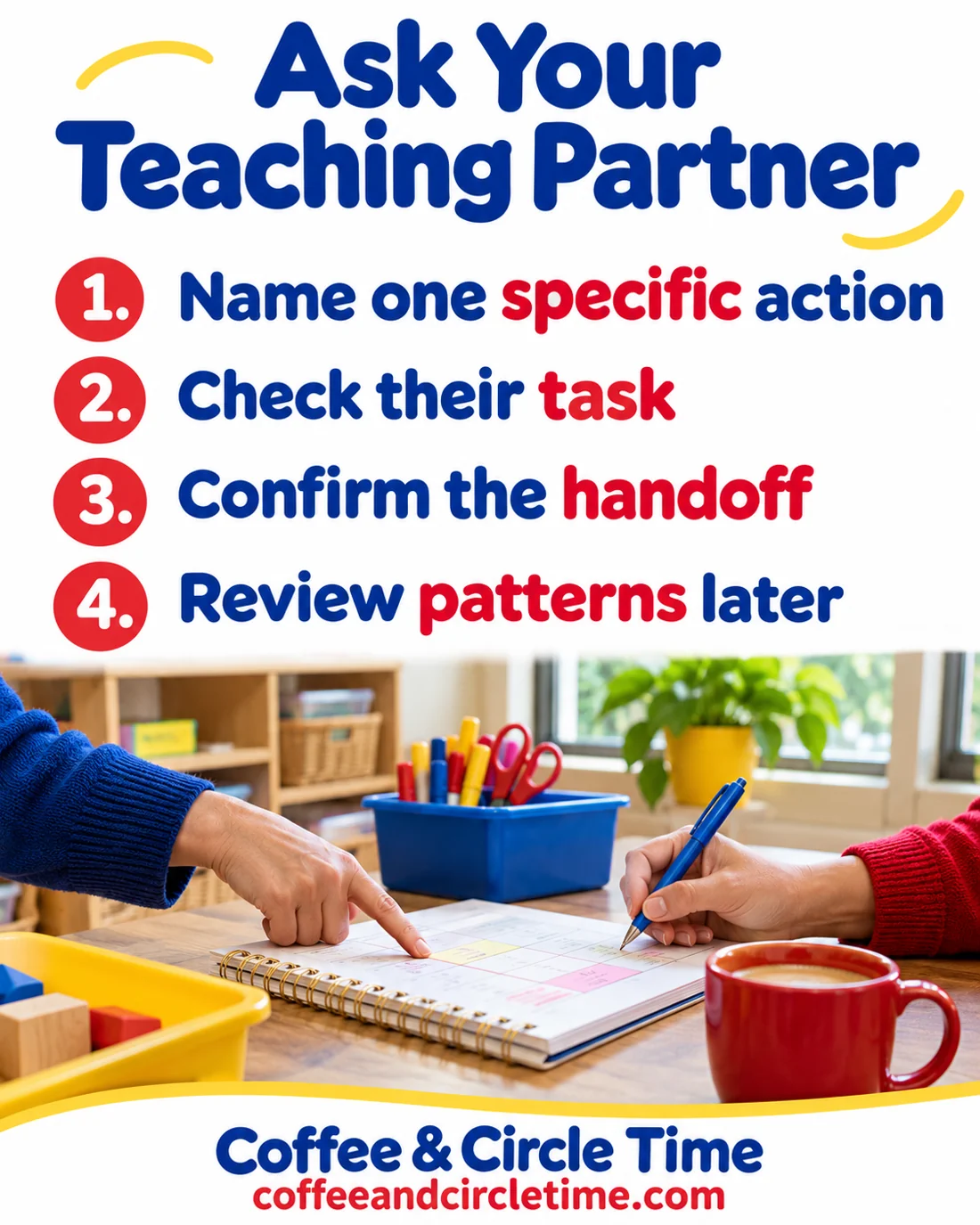
Check what your partner is already managing
Another adult may be supporting a child or completing a required procedure you cannot see. Ask in a way that allows them to identify that conflict.
If both tasks are essential, use the school’s process for obtaining additional support. Neither person should silently abandon a responsibility.
A clear request and a clear response are safer than assuming another adult noticed the need.
Confirm the handoff
Use a brief acknowledgment so both adults know who is doing what. Do not leave a supervision area based only on an unanswered request.
Keep the language calm and direct. You can be respectful without adding a long explanation while children are waiting.
Once the task is complete, communicate the next handoff just as clearly. Shared work needs a visible beginning and end.
Save the wider discussion for later
If the same difficulty happens repeatedly, arrange an appropriate planning conversation. Describe the recurring situation and the task distribution rather than making a statement about someone’s character.
Bring one example and one possible adjustment. “During cleanup, we both give directions while the sink area waits” is more actionable than “Nothing works.”
Keep children and families out of adult disagreements. A busy classroom is not the place to settle a personal conflict.
Agree on useful signals
During planning, decide which brief phrases or cues your team will use. Make sure covering adults also understand them where relevant.
Do not rely on a signal that can be mistaken for something else or requires the other adult to watch you constantly.
Review how you will request support when the other person cannot leave their own task. The backup plan should come from your setting’s procedures.
Notice what improves
After trying a new division of tasks, check whether both adults understand the plan and whether the difficult moment is more manageable.
Thank your partner for the specific action that helped. This keeps appreciation connected to real teamwork rather than a vague expectation that they always rescue you.
If the problem involves insufficient staffing or unclear responsibilities, involve the appropriate leader. Better wording alone cannot solve every workplace barrier.
Ask for one clear action and make responsibility explicit before moving on.

Leave a Reply