
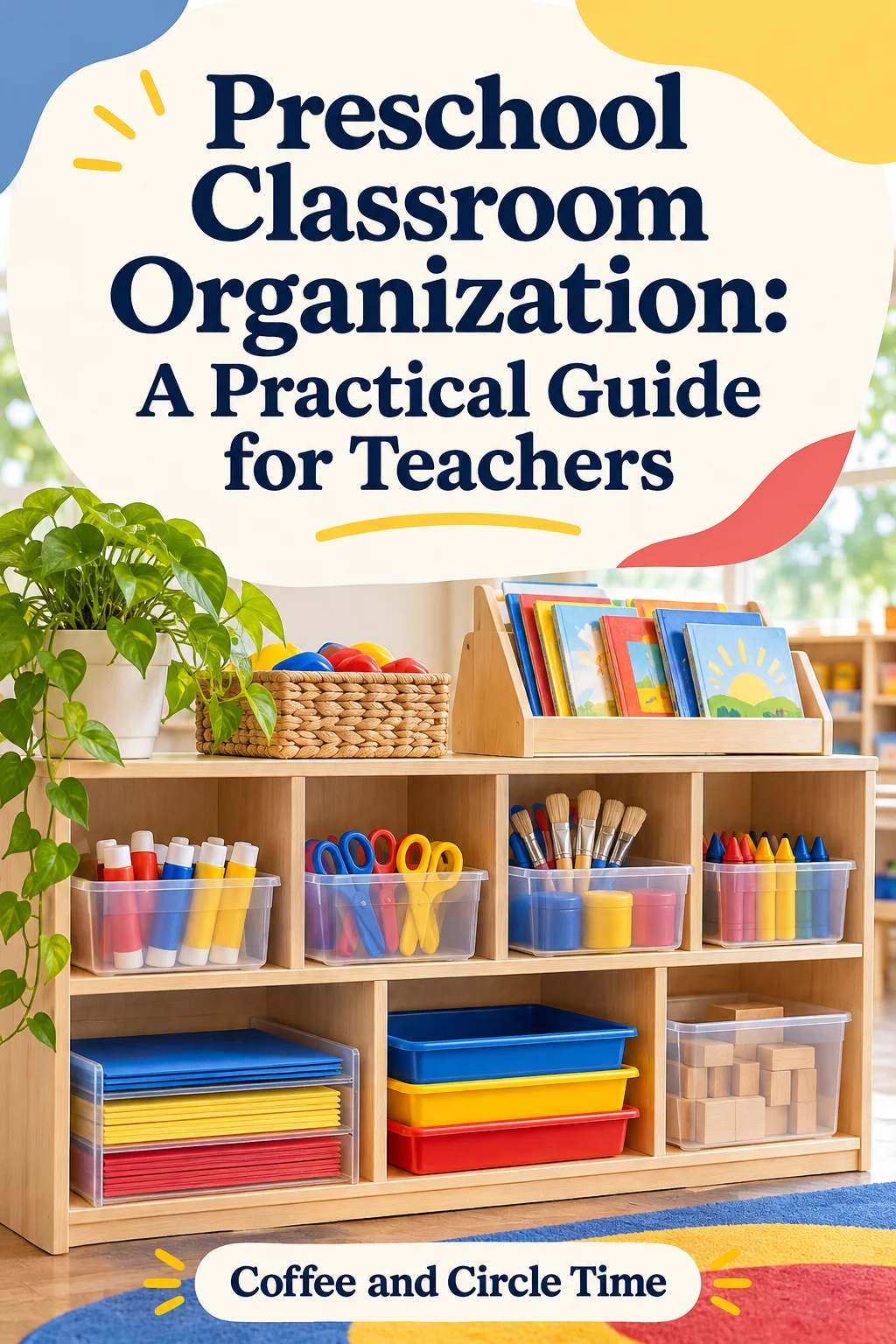
Preschool classroom organization works best when materials have clear homes, daily responsibilities are easy to find, and the system can survive a busy teaching day. Start with the spaces and tasks that create the most repeated searching.
You do not need matching containers or a complete room makeover to begin. A small change to the shelf you use every day can be more useful than reorganizing a cupboard you rarely open.
Hi, I’m Ms. Jenn, a preschool teacher with 20 years of experience. I currently teach in a two year old classroom and share practical ideas from everyday teacher life here at Coffee and Circle Time.
This guide connects the practical parts of teacher organization: supplies, lesson preparation, books, paperwork, planning, and the end of day reset. Use the related articles when you need a specific solution.
If you want a place to write the plan, explore The Organized Teacher printable bundle. It includes pages for priorities, activity preparation, supplies, dates, and other classroom planning tasks.
Start here: your quick plan
- Pick one repeated source of searching or confusion.
- Give frequently used materials a clear home.
- Separate official records from personal planning.
- Choose a small closing reset your team can maintain.
Jump to a section
- 1. Organize around use, not appearance
- 2. Choose one daily frustration as your starting point
- 3. Give classroom supplies a clear home
- 4. Make labels meaningful
- 5. Prepare lesson materials without overplanning
- 6. Keep books findable
- 7. Give unfinished projects a place
- 8. Separate official records from personal planning
- 9. Keep your daily list realistic
- 10. Rotate thoughtfully instead of moving everything
- 11. Make shared information easy for another adult to use
- 12. Close the day with a small reset
- 13. Build a system you can return to
PART 1 OF 4
Start with the spaces you use most
1. Organize around use, not appearance
Ask what happens in a space before buying anything for it. Who uses the materials, how often do they need them, and what support do they need to put them back?
- Children’s everyday materials should have homes that make sense to them. Adult supplies can be stored separately according to your program’s requirements and the supervision needs of the room.
- A shelf can look tidy and still be difficult to use. If every basket must be moved to reach one common item, the arrangement may need simplifying.
NAEYC’s article on planning preschool spaces for individuality offers a helpful reminder to consider the children using the environment. Your storage should support access and participation, not only adult convenience.
2. Choose one daily frustration as your starting point
Write down the moment that most often interrupts your work. It might be searching for glue, gathering a book, locating a form, or figuring out what needs preparing tomorrow.
- Look at the physical route involved. A frequently used item may need to move closer to its point of use rather than into a new decorative container.
- Set a narrow goal: “The painting tools will be together on this shelf” is easier to finish than “I will organize the art area.”
The best first project is small enough to complete and useful enough to repeat.
Once that space works, move to the next recurring problem. This approach lets you improve the room without making every storage area temporarily unusable.
3. Give classroom supplies a clear home
Group materials by the way you actually use them. Keep regularly paired items close enough that preparation does not require several trips across the room.
- Check what your program already provides before making purchases. Use available storage where possible, and follow your setting’s process for requesting supplies.
- Separate everyday materials from occasional extras. Too much choice in the active area can make it harder to see what needs refilling.
For more detail, read how to organize craft supplies in a small classroom. A useful system makes the next action obvious to you and to the other adults who use the space.
PART 2 OF 4
Keep materials ready and findable
4. Make labels meaningful
Choose labels that match the person using the storage. A child may benefit from a clear photo of the contents, while an adult planning cupboard may work well with simple words.
- Keep categories broad enough to be manageable. If an item could reasonably belong in several bins, agree on one home with your teaching partner.
- Place the label where it can still be seen during use. A label hidden behind the materials will not help much at cleanup.
Check whether the arrangement is accessible for the children in your room. A label alone cannot solve a container that is too heavy, a shelf that is too high, or a crowded route.
5. Prepare lesson materials without overplanning
Review the upcoming experiences and gather what you genuinely expect to use. Keep the plan flexible enough to respond to children’s interests and the realities of the week.
- Use a tray, shelf, or designated container for the next activity. Separate what is ready from what still needs an adult decision.
- Write the missing step clearly. “Choose a book about building” is more actionable than a note that simply says “lesson plans.”
The article on organizing lesson materials for the week walks through a practical setup. Avoid preparing so much at once that the next few days become difficult to see.
6. Keep books findable
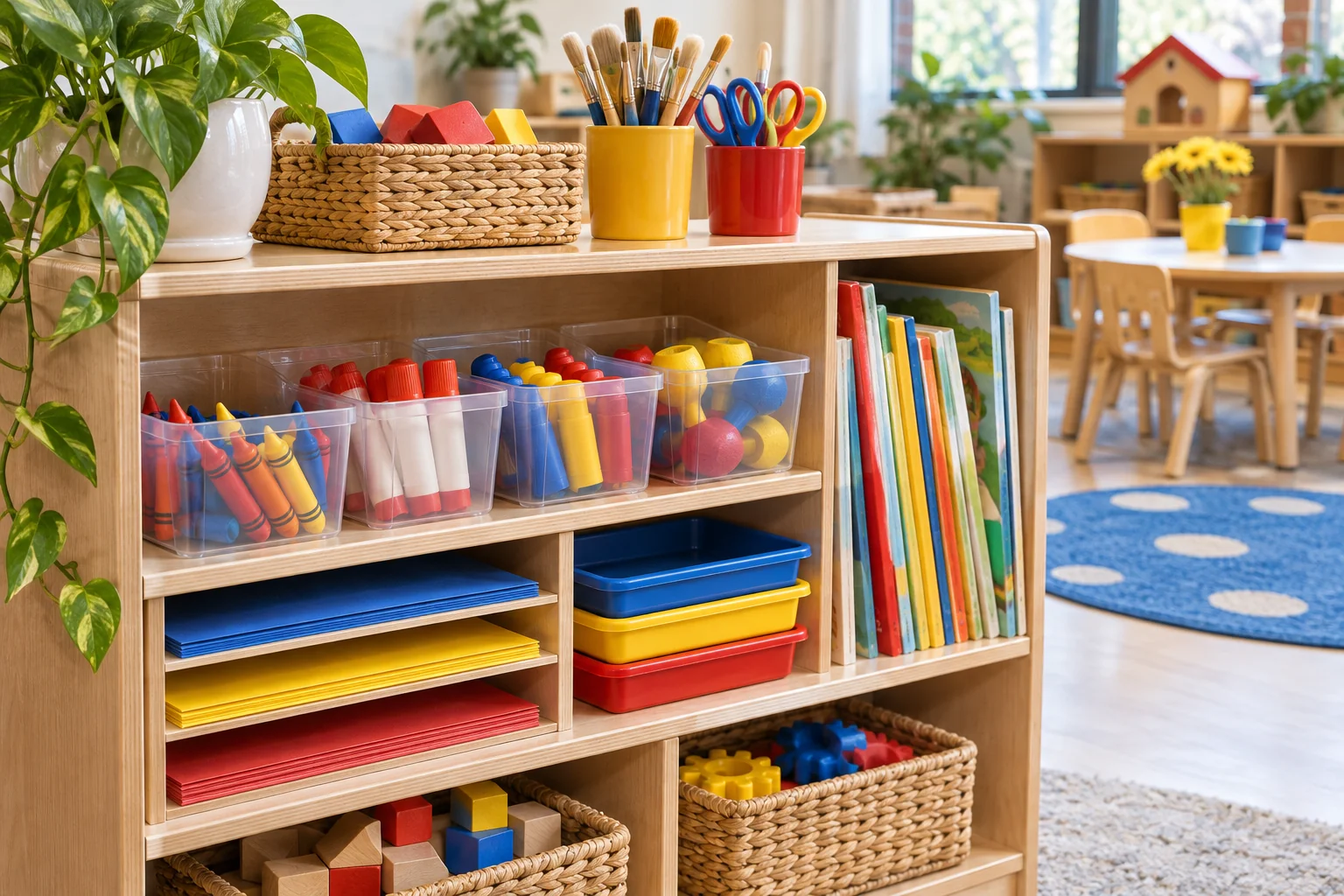
Choose one main home for classroom books and a simple way to track temporary groups. You might keep a small set together for an upcoming theme or interest, then return it afterward.
- Use categories your team can maintain. An elaborate system is not helpful if no one knows where to return a book after reading it.
- Keep children’s browsing in mind too. Display a manageable selection where books can be seen and handled appropriately.
Read how to organize preschool books by theme without losing them for a closer look. The goal is to find the book again, not to make every title fit a complicated catalog.
PART 3 OF 4
Simplify the planning and paperwork
7. Give unfinished projects a place
Plan where work will go before starting an activity that needs drying or another session. Leave enough room that one child’s project does not have to be moved repeatedly to reach another.
- Use the identification method your setting allows. Keep names and children’s information handled in the appropriate way for your program.
- Explain what will happen next so children know whether they can return to the work. Unfinished does not have to mean forgotten.
For practical storage ideas, read how to store unfinished preschool art projects. Keep the storage route simple enough that you can use it while maintaining appropriate attention to the group.
8. Separate official records from personal planning
Use your program’s required systems for attendance, child information, incident documentation, and other official records. A personal planner should help you remember tasks without replacing those systems.
- Create a clear place for items that need action and a separate home for completed paperwork. Follow your setting’s expectations for privacy, access, and storage.
- Avoid bringing confidential child or family details into an unsecured personal notebook or device. Record a general reminder to complete the task in the approved system instead.
Read how to keep preschool paperwork from piling up for everyday organization ideas. If the process itself is unclear, ask your supervisor where each type of document belongs.
9. Keep your daily list realistic
Start with required responsibilities and time sensitive preparation. Add only a small number of optional improvements.
- Write tasks as actions you can recognize as finished. A reminder to “check the glue supply” gives you a clearer next step than a reminder to “get ready.”
- Do not treat supervision time as an empty planning block. Match tasks to the work periods and staffing arrangements actually available to you.
The guide to a preschool teacher’s daily to do list helps separate essential tasks from useful extras. If required work consistently exceeds available time, discuss priorities with your supervisor.
PART 4 OF 4
Share the system and reset for tomorrow
10. Rotate thoughtfully instead of moving everything
A material rotation can be a small substitution. Keep familiar storage locations where they still work so adults and children do not have to relearn the room each week.
- Observe what is being used before deciding what to change. Sometimes presenting an existing material differently is more useful than adding something new.
- Keep reserve materials organized enough that you can find them when needed. Avoid turning storage into a pile of forgotten possibilities.
For a practical approach, read how to rotate materials without reorganizing the whole room. Make the change serve the children’s play rather than the pressure to keep the room looking different.
11. Make shared information easy for another adult to use
Agree on where important daily information lives. Your teaching partner should not need access to your memory to find the plan or understand which supplies need attention.
Prepare a substitute folder through your setting’s approved process. Keep the information current and make sure sensitive details are included only where and how your program permits.
Use the preschool substitute folder guide as a starting point. Confirm the final contents with your supervisor rather than assuming a generic checklist covers your workplace.
For ideas you want to revisit later, see how to remember activity ideas without saving everything. One dependable place is easier to search than several abandoned lists.
12. Close the day with a small reset
Choose a few actions that make the next opening easier. Restore an active shelf, check tomorrow’s essential materials, and put urgent reminders where the right adult will see them.
Keep the reset within your assigned work responsibilities and available time. A complete room transformation is not the standard for leaving.
Read what to reset before leaving a preschool classroom for a manageable ending. A useful closing routine prepares the next day without creating an endless list.
13. Build a system you can return to
Choose one shelf, one pile, or one planning task today. Give it a clear home and try the arrangement during an ordinary week before expanding it.
Visit the Coffee and Circle Time printables page if a supply log, preparation checklist, or daily priorities page would help. Start with the page that solves your current problem, then keep the organization as simple as your day needs it to be.
Keep exploring the Teacher Organization articles for focused answers to everyday classroom questions.

Leave a Reply