
Separate paperwork by its next required action, use the school’s approved storage and review incoming items at a predictable time. A paper pile becomes easier to manage when forms needing action are not mixed with records already completed.
Give each paper a next action and a proper destination instead of a permanent place in a pile.
Hi, I’m Ms. Jenn, a preschool teacher with 20 years of experience. I currently teach in a two year old classroom and share practical ideas from everyday teacher life here at Coffee and Circle Time.
Identify the kinds of paper
Sort the work by function: something to complete, something to pass on and something to file through the approved process. Follow your program’s rules for records and retention.
Do not discard documents based on a general decluttering rule. Ask the appropriate school contact when you are unsure what must be kept.
A personal organization system should not change the school’s official record requirements.
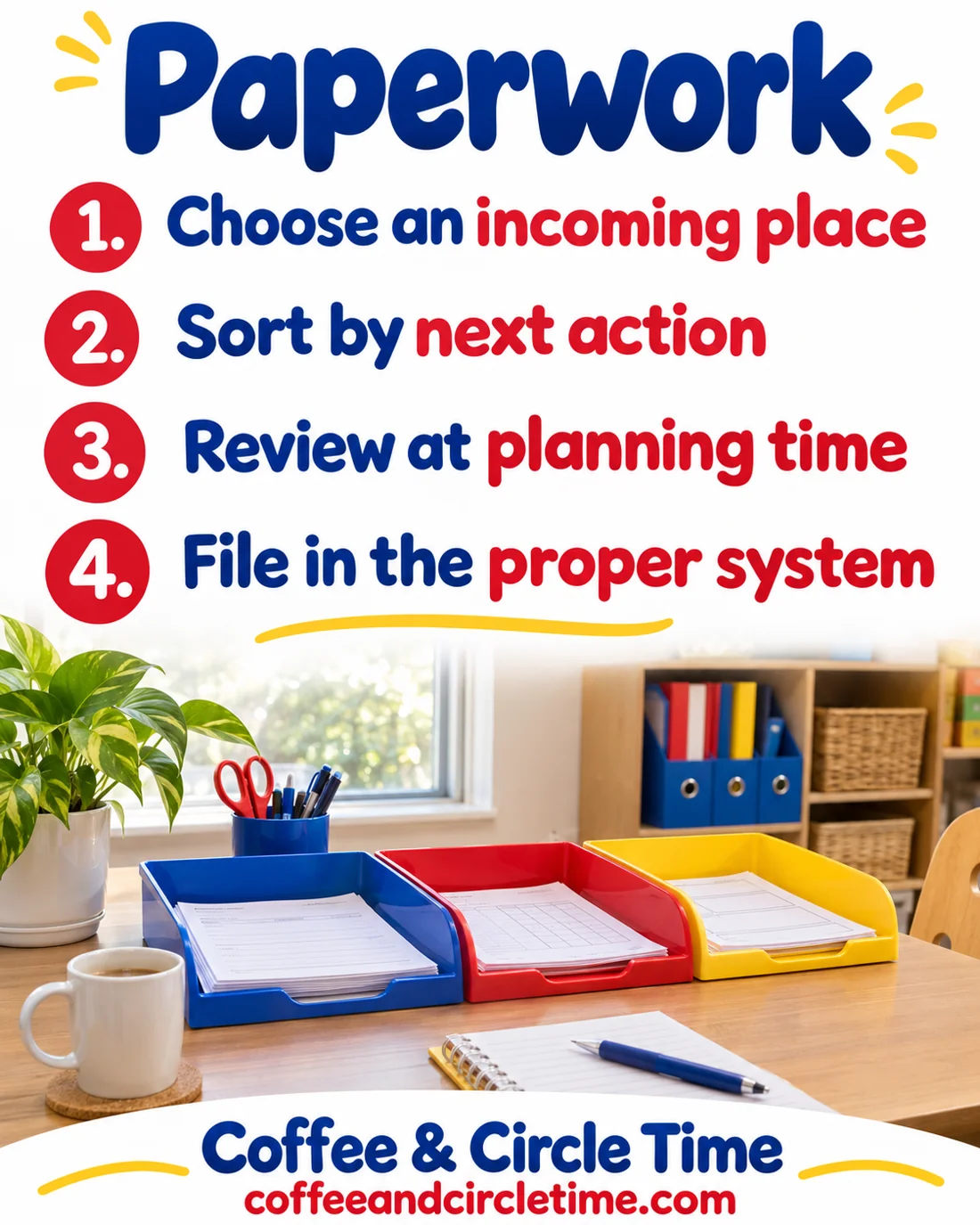
Create a clear incoming place
Choose an approved location for new items so they do not spread across several surfaces. Keep confidential material protected from unauthorized access.
Tell your teaching partner how the incoming system works. Otherwise, papers may continue arriving in bags, books and unrelated trays.
The first useful step is knowing where new paperwork goes before you have time to process it.
Sort by the next action
Mark the action in plain language, such as complete, return or confirm. A label that only says important does not explain what you need to do.
Keep deadlines in the approved planning system rather than relying on the position of a paper in a pile.
For an item that needs another person’s response, note who is responsible and how you will follow up through the appropriate channel.
Use a realistic review time
Choose a brief review during an appropriate planning period. Do not turn paperwork organization into a competing task while active supervision needs your attention.
Start with items that affect the next day or have a confirmed deadline. Then process the remaining papers by their next action.
If the required workload does not fit the time available, raise that practical issue with your supervisor rather than quietly creating an unmanageable home routine.
Finish the filing step
Once an action is complete, move the record to its approved destination. Keeping completed papers in the active tray makes the workload look larger than it is.
Avoid creating duplicate personal files of sensitive information. Use the school’s designated system and access rules.
If an original must go elsewhere, make the handoff clear and follow the relevant procedure rather than leaving it on an unnamed desk.
Prevent recurring piles
Notice which items repeatedly stall. Perhaps the instructions, owner or destination are unclear. Resolve that question once where possible.
Review the system with the people who use it. A small shared change may remove more work than buying another organizer.
Keep the active system simple enough to reset on a normal day. Its purpose is to make required work visible and manageable, not to create another project.
Give each paper a next action and a proper destination instead of a permanent place in a pile.

Leave a Reply