
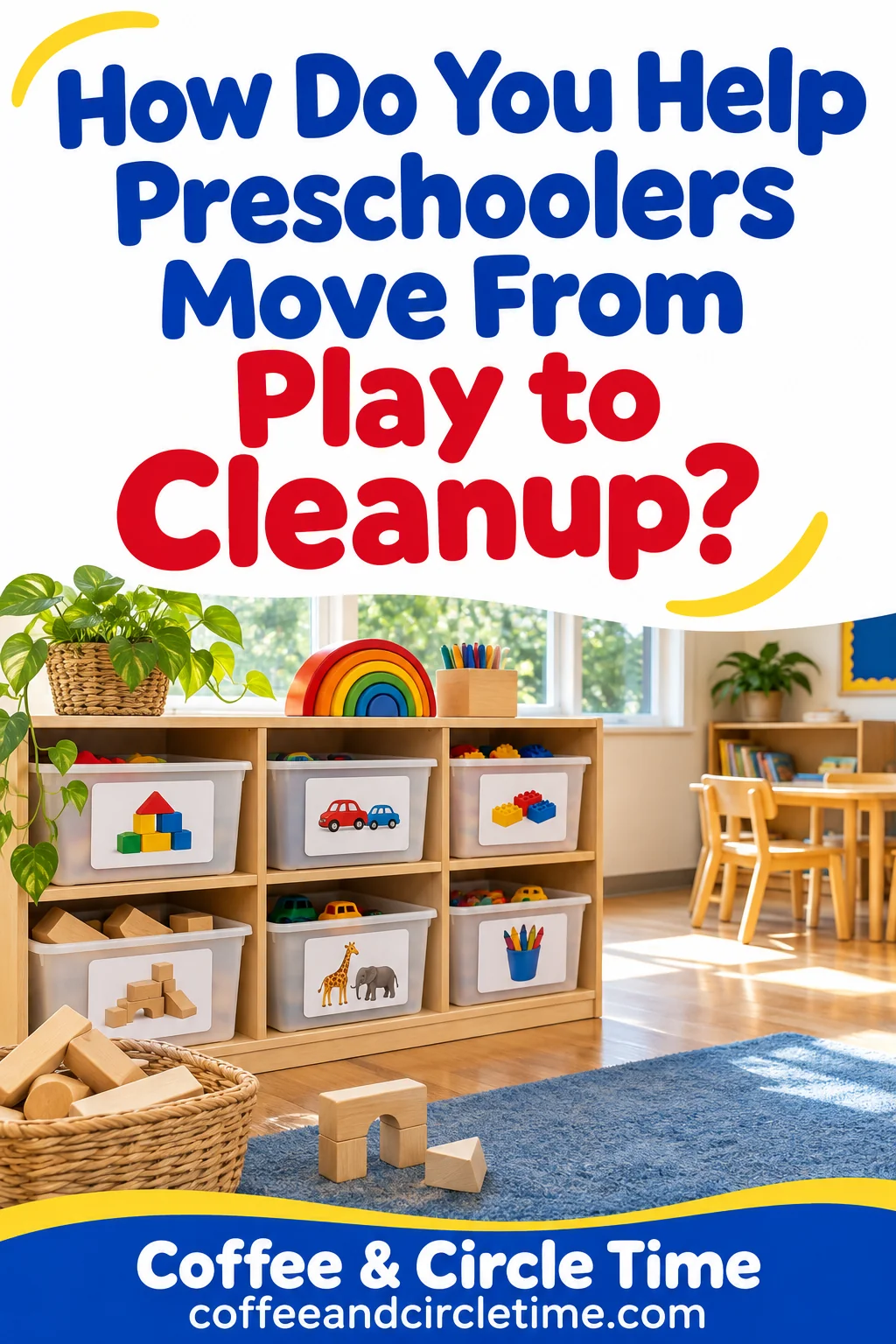
Give a predictable warning, show one concrete cleanup action and help children begin in a small area. Moving from play to cleanup is easier to understand when children know what happens to their work and what comes next.
Teach the first cleanup action clearly and make the next part of the day predictable.
Hi, I’m Ms. Jenn, a preschool teacher with 20 years of experience. I currently teach in a two year old classroom and share practical ideas from everyday teacher life here at Coffee and Circle Time.
In my classroom, I sing songs during transition times. Singing is one of the ways I guide children from one part of our day to the next.
For cleanup time, I play a specific song the children know. That familiar song cues them to start cleaning.
Some days, I also offer stickers during cleanup time.
A transition song is a tool I use alongside clear directions and support. The song does not need to replace explaining what children should do next.
Make the ending visible
Use your classroom’s familiar signal before cleanup begins. Pair it with a short explanation of the next event rather than several unrelated directions.
For example, tell children that blocks will be put away and then the group will go outdoors. Use the words and visual schedule already familiar to them.
Avoid promising a specific amount of time you cannot provide. A reliable short warning is more useful than repeated extensions.
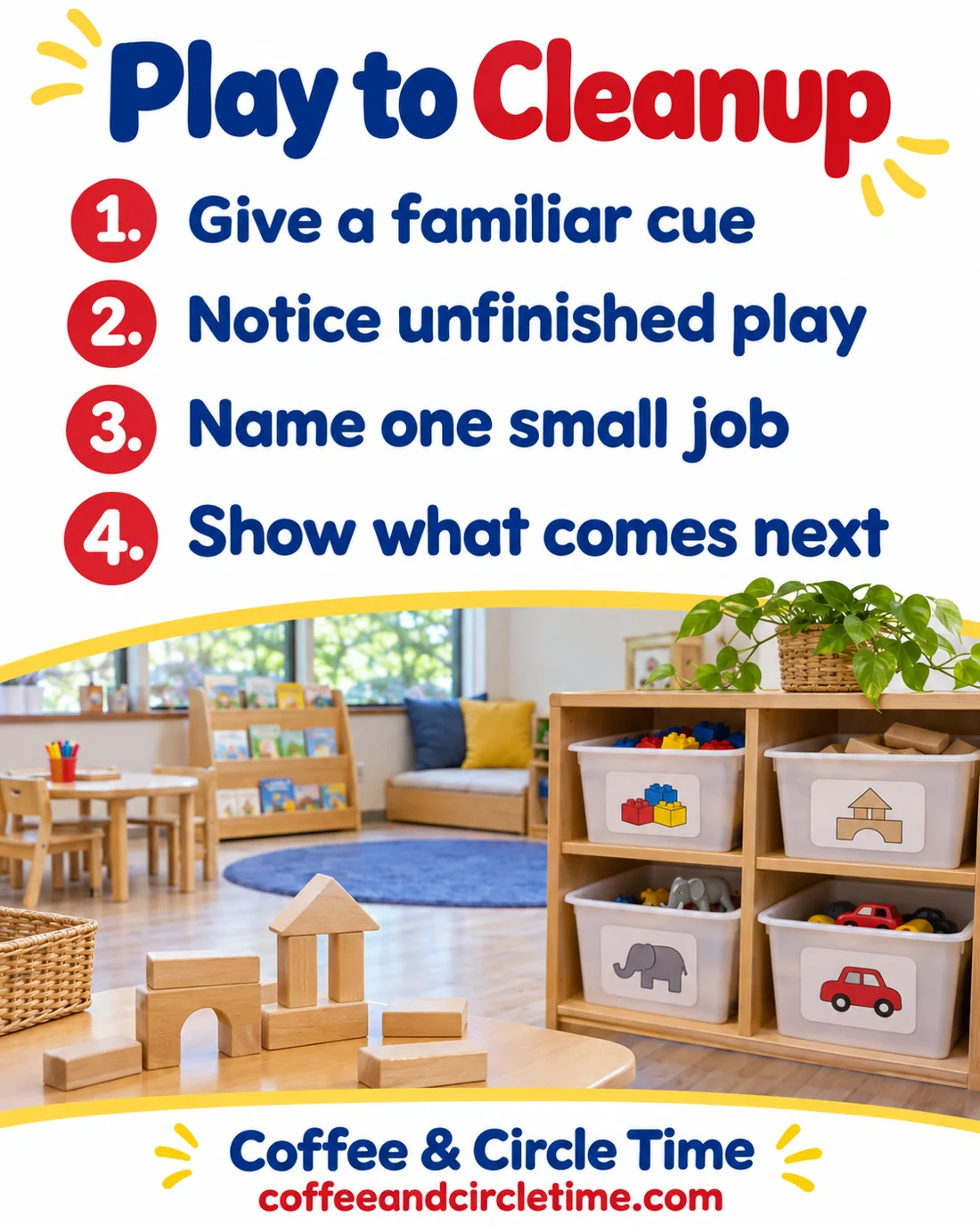
Respect unfinished play
Notice a structure or story before asking children to dismantle it. “You built a long road” acknowledges the work without promising it can remain.
If your room has a safe place for work in progress, explain the limits clearly. If it must be cleared, offer an approved way to remember it, such as describing the idea for later.
Children can learn a cleanup boundary while still having their play taken seriously.
Start with one manageable job
Point to a defined task: putting the cars in their bin or returning books to the shelf. “Clean this whole area” can leave a child unsure where to begin.
Work beside children when support is needed. Begin the action and invite them into the same sequence instead of repeating the instruction from across the room.
Keep labels and containers easy to understand. If adults cannot quickly tell where a material belongs, the storage system may need simplifying.
Reduce competition for the next activity
Avoid allowing the fastest cleaners to take every preferred place or item afterward. That can turn cleanup into a race rather than a shared routine.
Plan the next step so children can join without a long wait. When waiting is unavoidable, provide a familiar, supervised way to manage it.
Coordinate adult roles beforehand. One person giving a new direction while another continues play can make the boundary unclear.
Respond calmly when a child resists
Check whether the child understands the job, can physically do it or needs help stopping an absorbing activity. Offer a choice between two useful tasks.
Keep the expectation clear without turning it into a public argument. A brief prompt beside the child is often more actionable than a group reminder naming them.
If the pattern continues, observe when it happens and use the classroom support process. Avoid assuming every refusal has the same cause.
Review the routine after a few days
Notice where children get stuck: too many materials, crowded shelves, unclear categories or a long gap before the next activity. Change one part of the setup.
Teach the changed routine during a calm moment. Cleanup time is a difficult place to introduce a completely new sorting system.
Celebrate specific cooperation without comparing children. Describe the shared result: the walking space is clear and the materials are ready for tomorrow.
Teach the first cleanup action clearly and make the next part of the day predictable.

Leave a Reply