

Reduce the line first, then give waiting children one quiet, familiar action that fits your supervision plan. The handwashing routine works better when fewer children wait near the sink and adults can still see and support the whole group.
Shorten the wait where possible and keep the remaining waiting routine simple.
Hi, I’m Ms. Jenn, a preschool teacher with 20 years of experience. I currently teach in a two year old classroom and share practical ideas from everyday teacher life here at Coffee and Circle Time.
Look at why the line forms
Observe how many children arrive at the sink at once and where adults stand. A long line may be a scheduling problem rather than a listening problem.
Consider whether smaller groups can be called while another adult supervises the rest, following your setting’s staffing and hygiene procedures.
Do not change the handwashing steps to make the line move faster. Keep the hygiene routine your program requires.
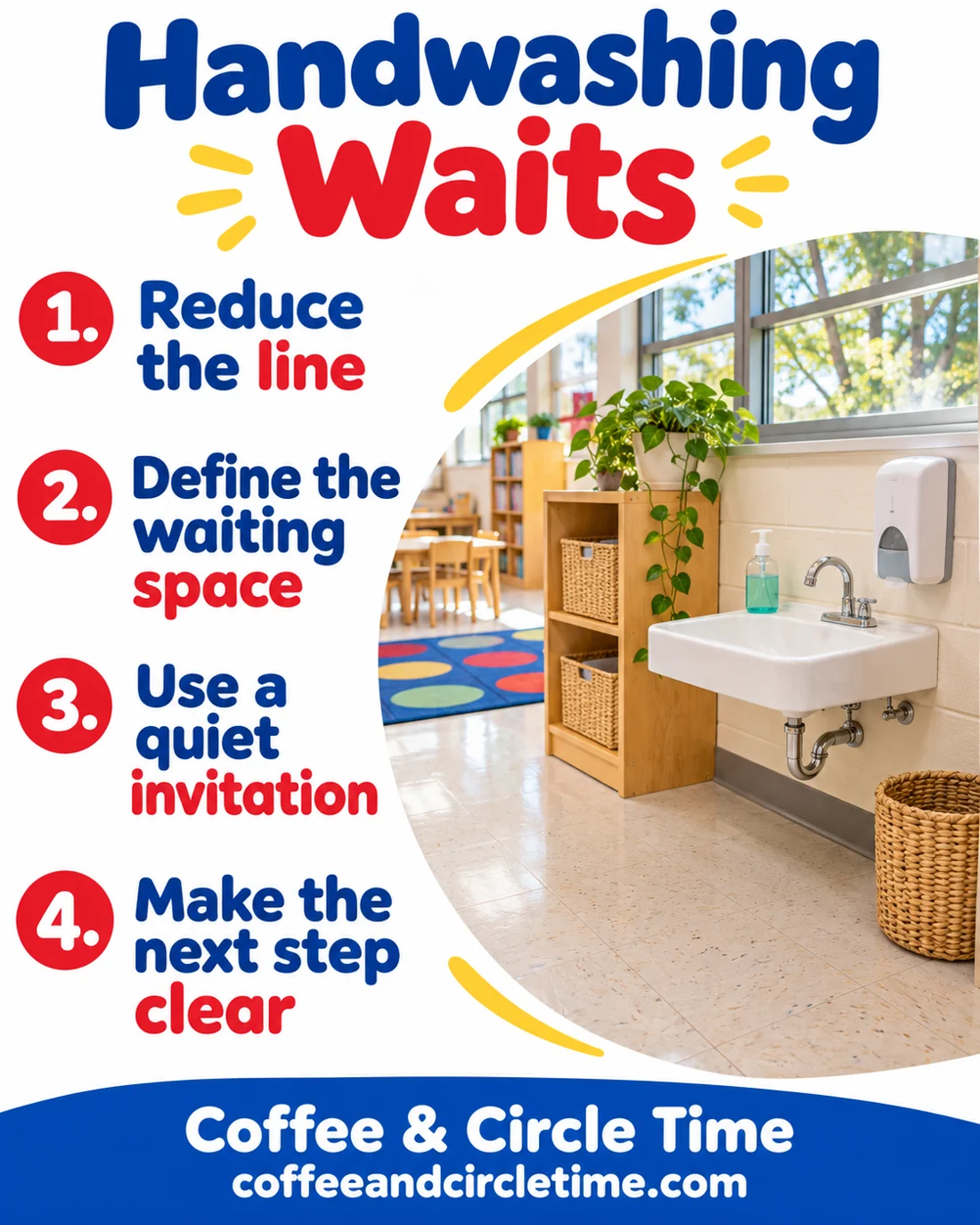
Define the waiting space
Show children where to stand or sit while keeping the sink, doorways and walking routes clear. Use visual cues already appropriate for your room.
Keep the waiting area within the supervision plan. Moving children somewhere quieter is not useful if an adult can no longer see them.
The best waiting activity cannot compensate for a line that is too long or poorly supervised.
Choose something that needs no supplies
Try a familiar quiet song, looking for a named color in the room or a short movement children can do in their own space. Keep it easy to stop when their turn comes.
Avoid handing out toys that will need sharing or collecting at the sink. Extra objects can make the transition more complicated.
Use invitations rather than a rapid series of quiz questions. A child can wait appropriately without performing for the adult.
Teach the turn sequence
When a child has a hard time waiting for a turn, I remind them that it is the other child’s turn right now. I reassure them that they will get a turn and that I have not forgotten them.
Explain what happens when one child finishes and the next approaches. A consistent phrase can help children know when to move.
Help children who need support using the sink or understanding the sequence. Waiting and handwashing are separate skills.
Avoid relying on one child to supervise the line. Adults remain responsible for the routine and the children’s safety.
Keep the next step ready
After washing, children should know where to go without needing another long instruction. Set up the next supervised location beforehand.
Follow your program’s procedures about keeping clean hands ready for meals or other activities. Do not create an alternative game that interferes with those procedures.
If children repeatedly return to the sink area, check whether the destination is clear and whether an adult is available there.
Adjust based on observation
Record the practical bottleneck rather than labeling the group impatient. Perhaps supplies are difficult to reach or the transition begins too early.
Talk with your teaching partner about one change to test, such as a different group size or clearer handoff between adults.
Keep the change consistent long enough to observe it. A predictable routine usually provides more useful information than a new waiting game every day.
Shorten the wait where possible and keep the remaining waiting routine simple.

Leave a Reply