
Use a familiar ending signal, gather children according to your setting’s supervision procedures and make the first indoor action clear. Plan the whole route, including belongings and handwashing, rather than treating the doorway as the end of the transition.
Plan the return as a sequence of supported actions, from the outdoor cue to the first indoor activity.
Hi, I’m Ms. Jenn, a preschool teacher with 20 years of experience. I currently teach in a two year old classroom and share practical ideas from everyday teacher life here at Coffee and Circle Time.
Plan before going outside
Know the indoor destination and which adult will support each part of the transition. Follow your program’s procedures for attendance, supervision and movement between spaces.
Check whether the route or entry area has a practical bottleneck. Wet clothing, crowded storage or a narrow doorway can change how much support is needed.
Keep any required supplies ready before the group returns. Children should not be left waiting while an adult searches for materials.
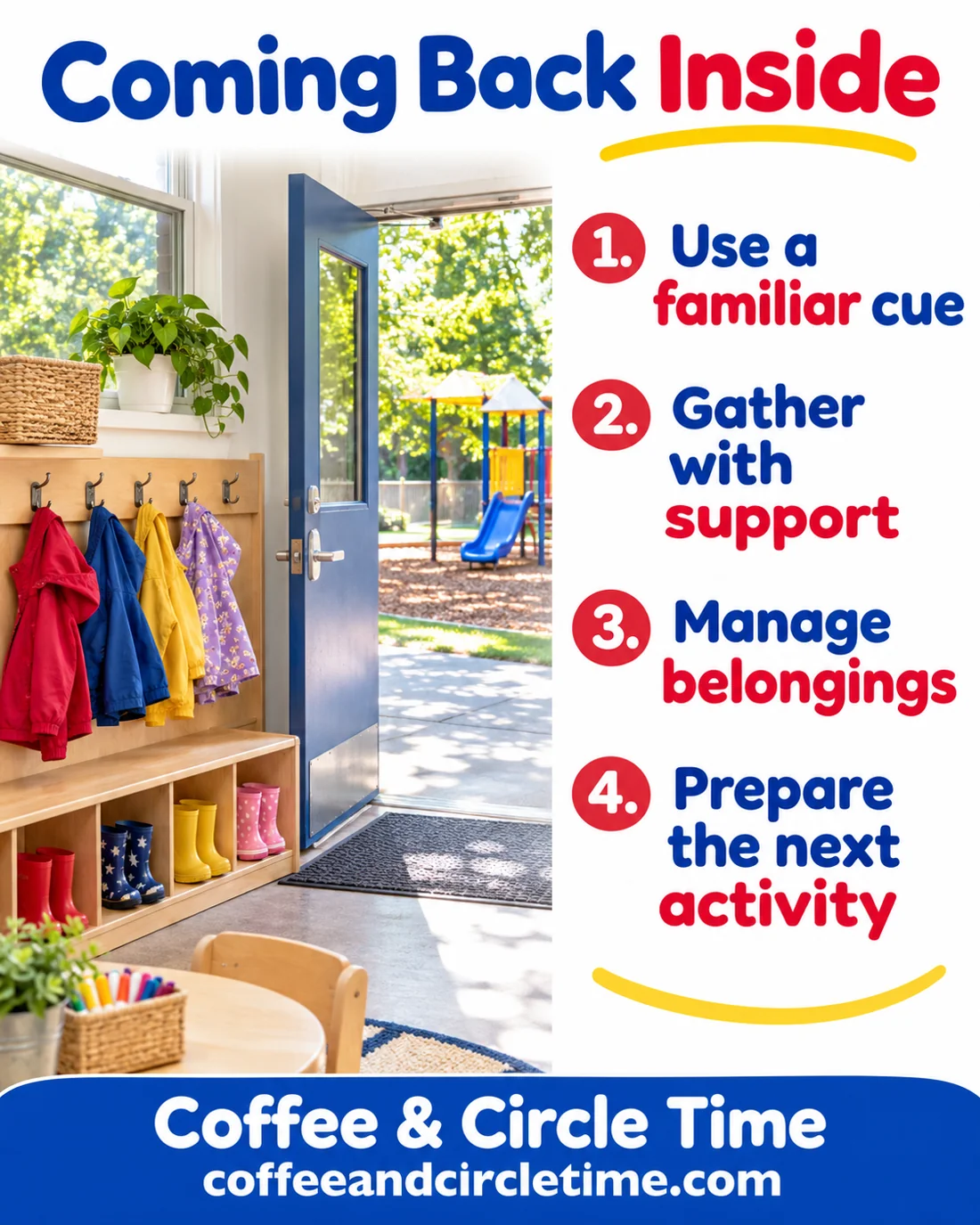
Signal the ending consistently
Use the cue children already know and briefly name what happens next. Give a suitable warning when the schedule allows.
Acknowledge unfinished outdoor play without promising that every structure or activity can remain. Explain the available choices within your setting.
Predictability is more useful than repeatedly inventing a new way to persuade children to come inside.
Make gathering an active teaching step
Show the expected gathering place and how children enter it. Use clear instructions and appropriate adult support rather than calling from far away.
Complete your setting’s required checks at the designated points. A familiar group does not remove the need for the normal supervision procedure.
Avoid turning gathering into a race. Speed should not become more important than keeping the group accounted for and supported.
Break the indoor sequence into parts
When we come inside after outdoor play, I have the children sit at the table and offer them water. That is part of our transition back into the classroom.
Once inside, give the next relevant instruction, such as placing a coat in its designated location. Save later directions until children can use them.
If handwashing follows, coordinate the group size and adult roles so a new line does not form immediately at the sink.
Some children need extra time with fastenings or changing clothing. Provide support without making them responsible for delaying the group.
Keep the first indoor activity manageable
Choose an available activity that children can enter while others finish the transition. It should work with the adults and space you have.
Avoid requiring everyone to sit silently through a long wait. Review whether the schedule can reduce that wait instead.
A familiar book or simple classroom choice may be more useful than a new activity requiring a full demonstration.
Review recurring difficulties
Notice the point at which children become unsure, crowded or frustrated. Record the situation rather than only the behavior that follows.
Talk with your teaching partner about a single adjustment. You may need clearer roles, more time for belongings or a better prepared destination.
Teach the revised sequence in a calm moment and use it consistently. Give children time to learn it before deciding that it does not work.
Plan the return as a sequence of supported actions, from the outdoor cue to the first indoor activity.

Leave a Reply