
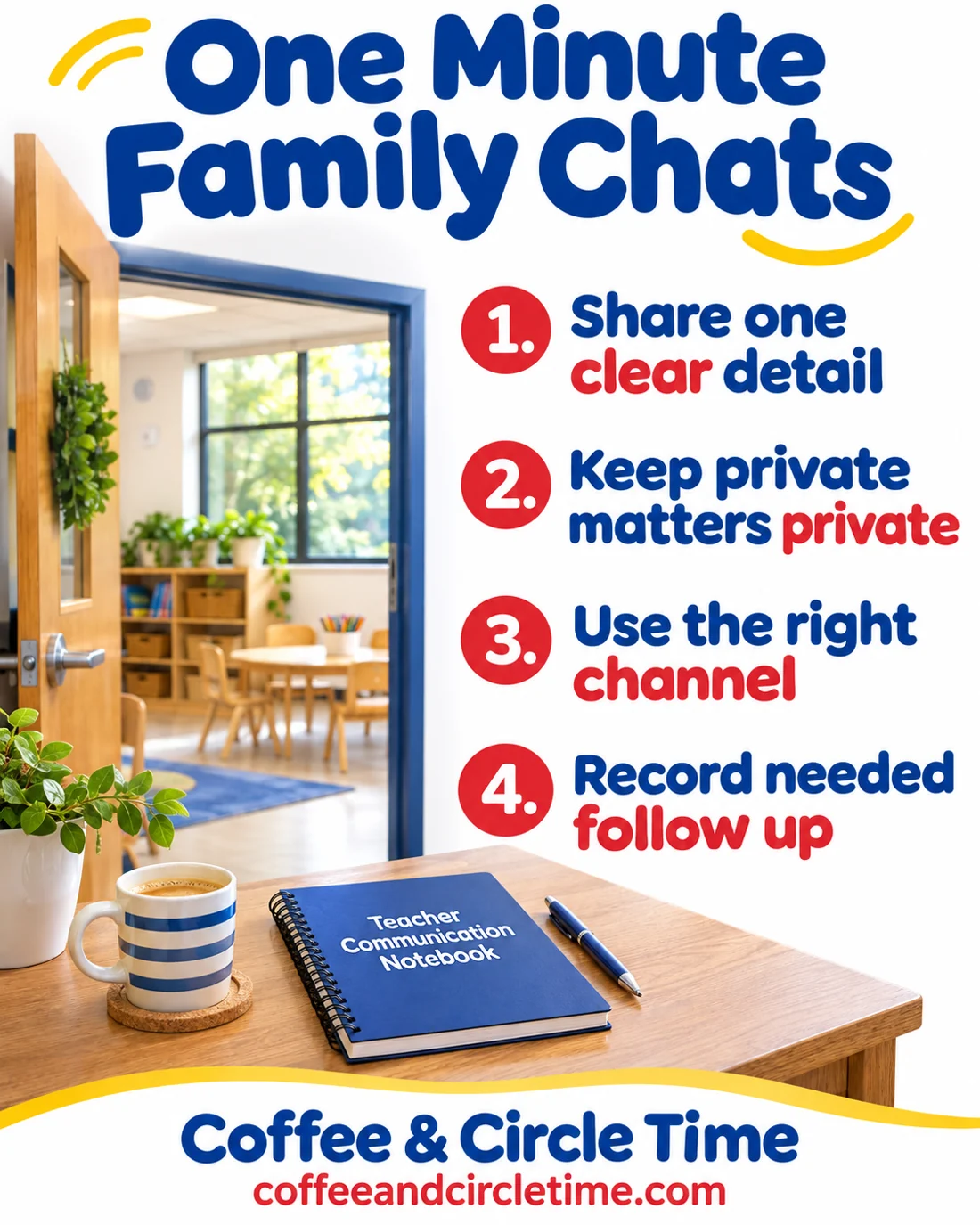
Share one clear, relevant observation and use the school’s approved communication channel for anything needing more time or privacy. A brief exchange can be warm and useful without trying to fit a full conversation into a busy doorway.
Share one useful detail and move longer or private conversations into the right setting.
Hi, I’m Ms. Jenn, a preschool teacher with 20 years of experience. I currently teach in a two year old classroom and share practical ideas from everyday teacher life here at Coffee and Circle Time.
Choose the purpose
Decide whether you are sharing a small moment, passing on a necessary practical message or arranging a longer discussion. Those conversations need different amounts of time.
Keep required incident or formal communication within your school’s procedures. A casual comment does not replace a required report.
Before speaking, check that your attention can remain on the children and the handoff responsibilities you are managing.
Use a concrete observation
Describe what you saw or heard rather than making a broad judgment. “She invited another child to build beside her” gives more information than “She was good.”
Keep the observation accurate and proportionate. One moment does not establish a lasting change or developmental conclusion.
A specific factual detail can communicate more than several general compliments.
Keep private matters private
Avoid discussing sensitive information where other families or children can hear. Do not identify another child when explaining an interaction.
Use the approved process for health, support or family concerns. Arrange a private conversation with the appropriate staff involved.
If a family begins a sensitive discussion in a public area, acknowledge it and offer the proper next step without inviting more details there.
Make practical messages clear
For a routine reminder, say what is needed and when, using the school’s current information. Avoid adding assumptions about why a family has not done something.
Check whether the message has already been sent through another channel. Repetition can be helpful, but conflicting versions create confusion.
If you are unsure of the answer, say you will check through the appropriate process rather than guessing.
Give the family a route to continue
Explain how to contact the right person or arrange a conversation under school procedures. Do not promise a response time you cannot control.
Keep your personal contact details and private social accounts separate unless your workplace explicitly uses them for that purpose.
Record a necessary follow up in the approved system. A meaningful concern should not depend on remembering it after a long day.
Let brief contact be enough
You do not need a new story for every family every day. A warm greeting and accurate handoff can still be valuable.
Look for a fair pattern over time so the same families are not always missed. Use your team’s communication approach rather than a public scorekeeping system.
If there is too much information for the time available, change the channel or arrange a longer conversation. Speaking faster is rarely the best solution.
Share one useful detail and move longer or private conversations into the right setting.

Leave a Reply