

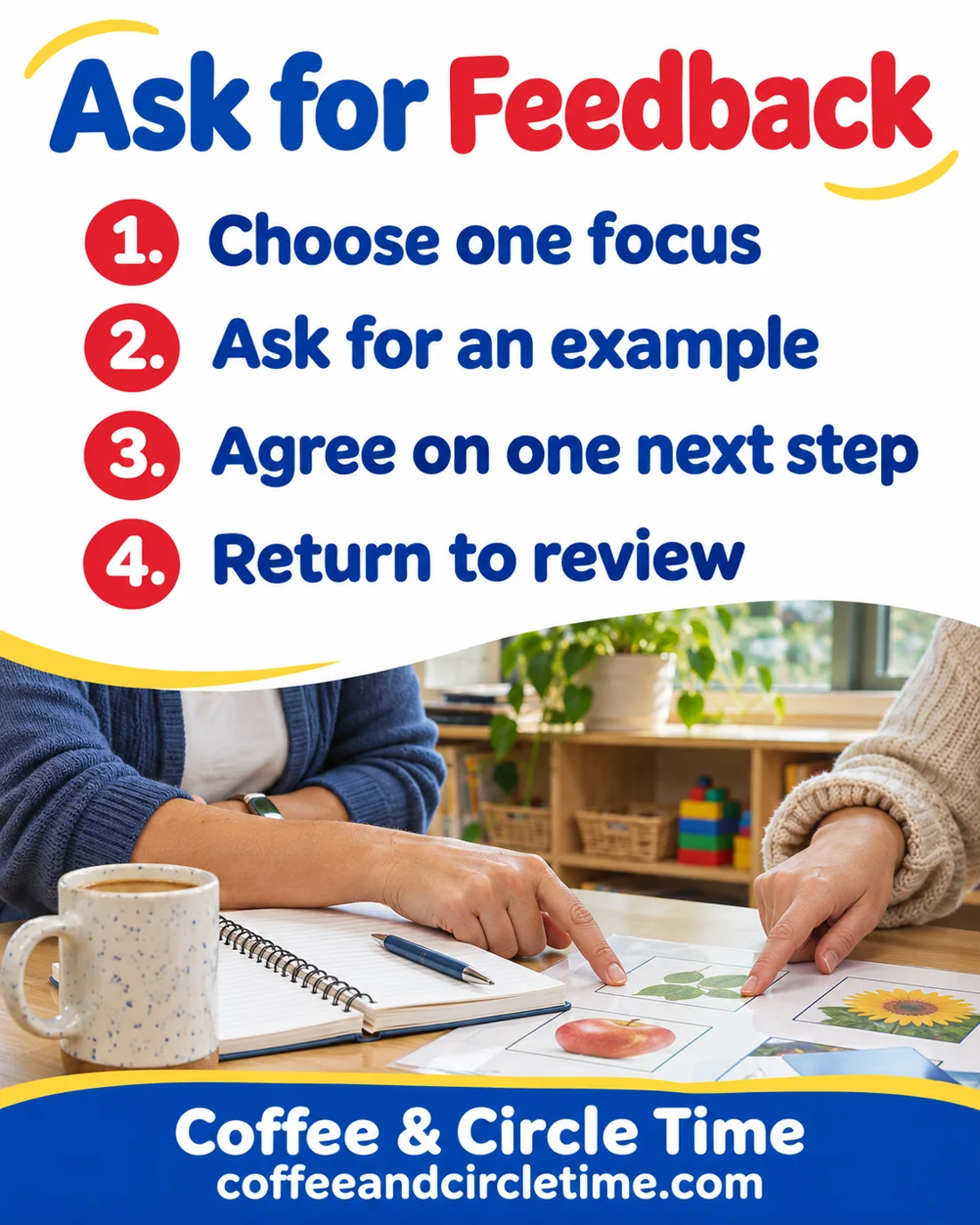
Ask the appropriate supervisor or teaching partner about one specific part of your work, request an example and agree on a next step. Focused feedback is easier to use than a broad question about whether you are doing well.
Ask about one observable part of your work and turn the feedback into a clear next action.
Hi, I’m Ms. Jenn, a preschool teacher with 20 years of experience. I currently teach in a two year old classroom and share practical ideas from everyday teacher life here at Coffee and Circle Time.
Choose a useful focus
Pick a routine or responsibility you want to understand better. Arrival, giving directions or preparing a small group can provide a clear starting point.
Avoid asking someone to judge your entire ability in a rushed moment. They may only be able to offer a vague reassurance.
If you are unsure which responsibility matters most, ask your supervisor what you should prioritize in your current stage of training.
Ask at an appropriate time
Request a short conversation during the process your workplace uses for planning or supervision. Avoid a detailed discussion while either adult needs to focus on children.
Tell the person what you want to review so they can bring a relevant observation. You do not need to prepare a long defense of your decisions.
A specific question gives the other person a clearer way to offer useful feedback.
Request an example
If the feedback is broad, ask what the person observed and what a helpful alternative would look like.
For example, if directions were unclear, ask which part children appeared unsure about. That gives you an action to adjust.
Listen for the difference between required school procedures and an individual preference. Ask for clarification when those seem mixed together.
Choose one next step
Agree on a manageable change and when you will try it. Too many adjustments at once make it difficult to know what helped.
Write the next action in an approved planning place if needed. Keep confidential child information out of a personal feedback notebook.
If you need training or resources to make the change, name that need. Feedback is more useful when the support required is clear.
Check your understanding
Briefly explain the action you plan to take so the other person can correct a misunderstanding.
You can ask questions respectfully without agreeing that every interpretation is complete. If an important point seems inaccurate, offer the factual context.
Use your school’s process for concerns about inappropriate or conflicting guidance. Do not try to resolve every workplace issue alone.
Return to the question
After trying the change, ask for a focused review. Explain what you attempted and what you noticed.
Keep useful feedback alongside evidence of what is becoming more familiar. Development is easier to see when you record specific actions rather than a global good or bad day.
A continuing conversation about practice is more helpful than waiting until you feel completely confident before asking anything.
Ask about one observable part of your work and turn the feedback into a clear next action.

Leave a Reply