
Look for the slowest part of the process, simplify where materials belong and reduce unnecessary waiting. Longer cleanup often reflects unclear storage or too many jobs at once, so changing the setup can help more than adding repeated reminders.
Find the bottleneck and change the routine at the point where children get stuck.
Hi, I’m Ms. Jenn, a preschool teacher with 20 years of experience. I currently teach in a two year old classroom and share practical ideas from everyday teacher life here at Coffee and Circle Time.
Observe before changing the system
Watch one cleanup from the first cue to the next activity. Notice whether children are sorting, waiting for space, asking where things go or wandering because they do not know their job.
Separate time spent actively returning materials from time spent waiting. Those two problems need different solutions.
Write down one recurring obstacle. Avoid deciding the entire class needs a new reward system before checking the practical details.
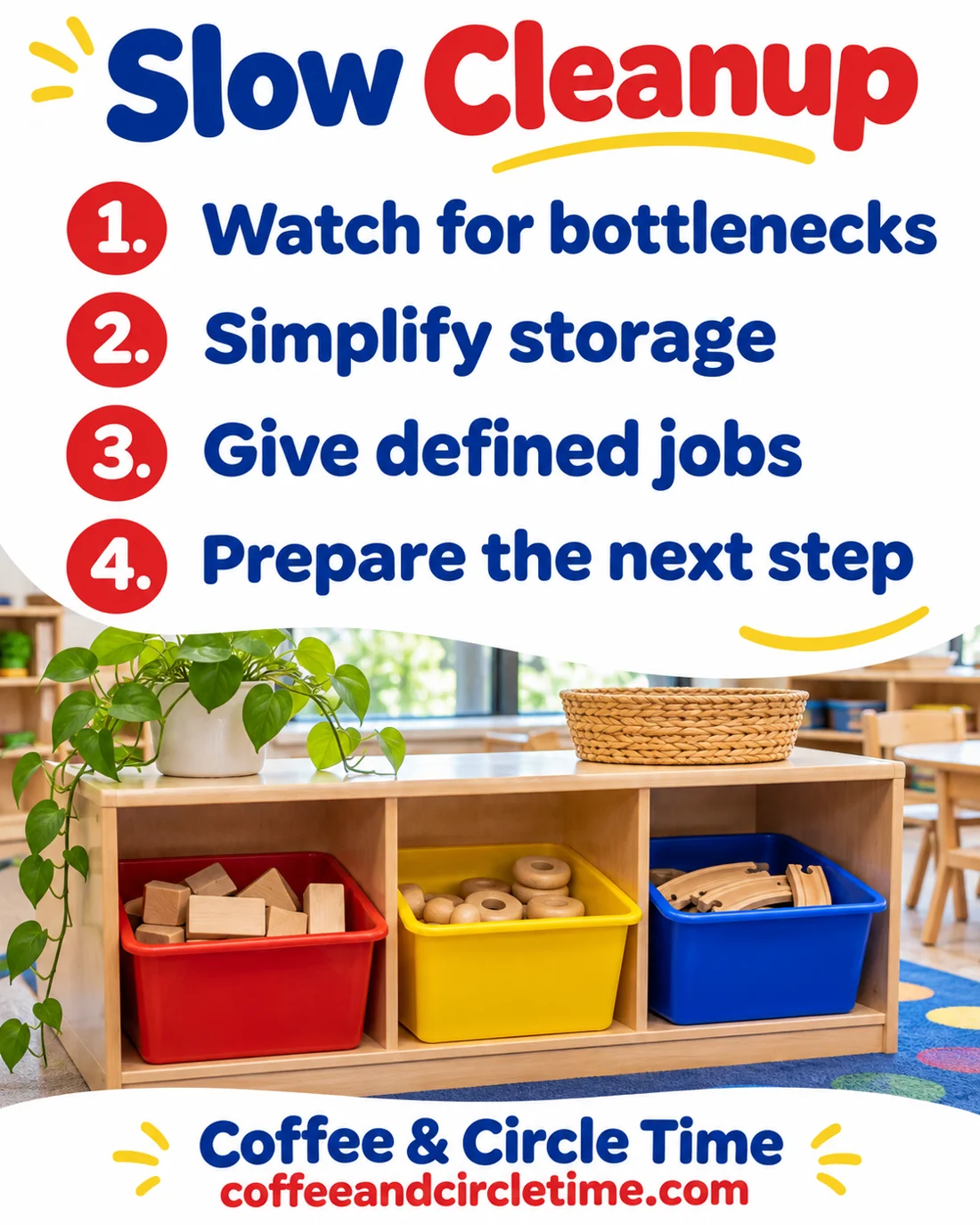
Simplify the storage choices
Use broad, meaningful categories where possible. If a container requires adult level sorting, children may not be able to return materials independently.
Check that labels match what actually belongs inside. A familiar photo or clear visual cue can help when it is appropriate for your room.
Storage should support the cleanup actions you expect children to perform.
Reduce the amount to manage
Review how much material is available at one time. Providing a smaller useful selection may reduce the cleanup load without reducing meaningful play.
Rotate supplies intentionally rather than keeping every option accessible because there is shelf space. Adults can replenish materials as needed.
Do not remove a valued activity as a surprise punishment for a slow transition. Explain changes as part of the classroom setup.
Give defined jobs
Offer a concrete task connected to the child’s play area. Returning the animals is easier to understand than helping with everything.
Join a difficult area and start one action beside the children. This can reveal whether the issue is understanding, access or the volume of materials.
Avoid repeatedly reassigning children before they finish. Clear ownership of a manageable job helps the sequence make sense.
Plan the handoff to the next activity
Prepare a supervised destination for children who finish. If everyone must wait in a crowded spot, cleanup may appear finished while the transition still feels chaotic.
Coordinate with your teaching partner so children receive the same direction. Follow your setting’s supervision requirements throughout.
Do not reward speed with exclusive access to every preferred choice. That can create rushed or incomplete cleanup.
Test one improvement
Choose the change most directly connected to your observation. It might be a clearer bin, less material or a different adult position.
Use the change for several ordinary cleanups and notice whether the specific obstacle improves. A single unusually busy day is not a complete result.
Keep the language calm and practical. Children are learning a shared process, and the adults can improve that process too.
Find the bottleneck and change the routine at the point where children get stuck.

Leave a Reply