
Preschool teachers may use nap time for their lunch break, quiet classroom tasks, and supervising children as they rest.
At my school, we take our lunch breaks during this part of the day, then use the remaining hour to clean, organize, or simply sit quietly while waiting for the children to wake up.
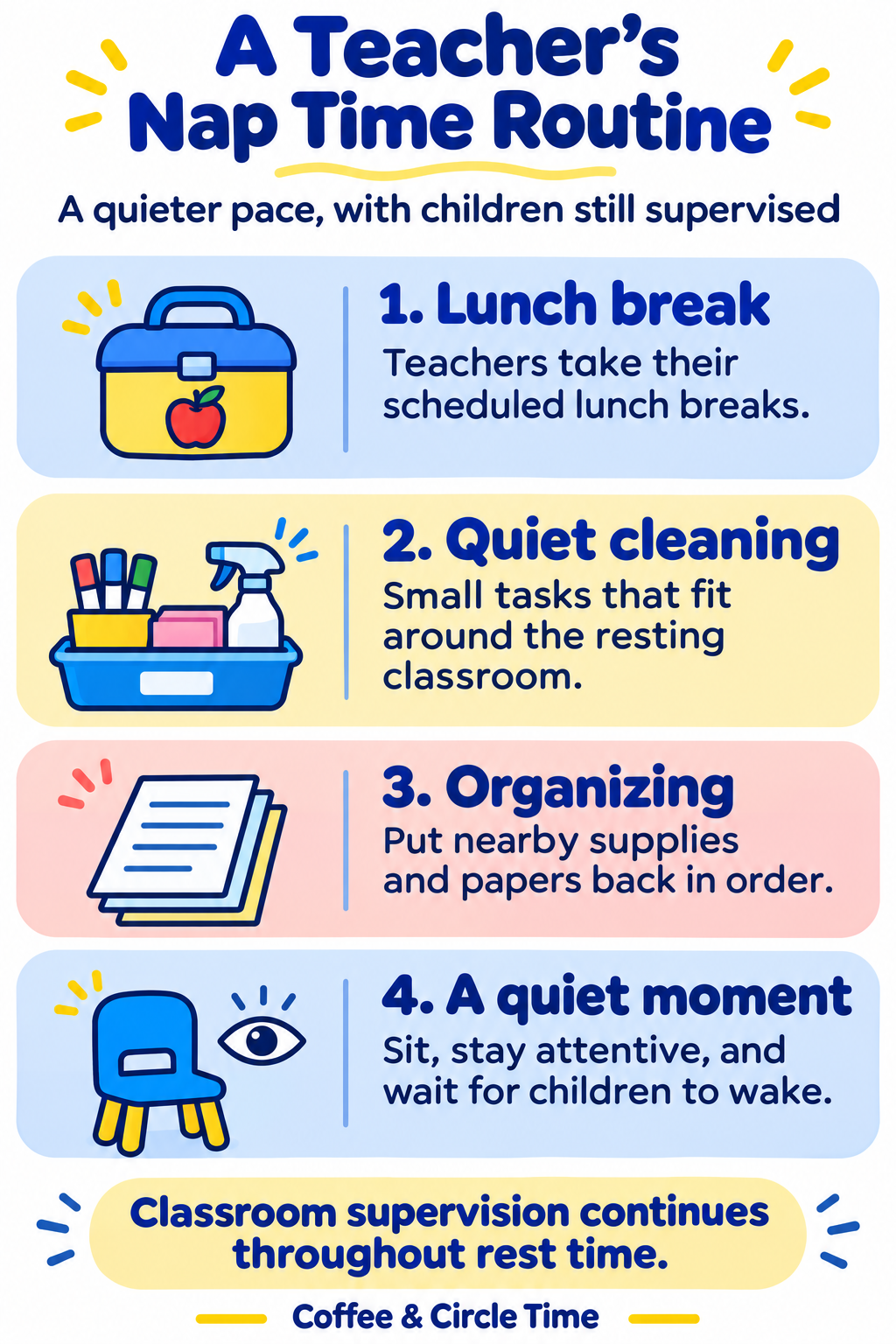
The room gets quieter, but the day does not stop. There are still children resting, children beginning to stir, and an afternoon routine waiting on the other side.
Hi, I’m Ms. Jenn, a preschool teacher with 20 years of experience. I currently teach in a two year old classroom and share practical ideas from everyday teacher life here at Coffee and Circle Time.
Here is what nap time looks like in my experience, including why some days feel productive and others are mostly about enjoying a quieter moment.
The short answer: lunch, quiet tasks, and supervision
- Scheduled lunch breaks with classroom coverage.
- Quiet cleaning and organization when the room allows.
- Calmer moments while children remain supervised.
- Helping children as they begin to wake up.
If you picture teachers spending the whole nap period on a long lunch break, that is not how it works at my school. We use part of the time for lunch, and there is still another stretch of the day afterward.
During that remaining hour, we might clean or organize things. Sometimes we relax and wait for the children to wake up.
Taking a lunch break and being the teacher responsible for the resting children are two different parts of the routine.
When I talk about relaxing in the classroom, I mean a quieter moment while the children are still being supervised.
That distinction matters because a silent room can look like an empty room from the outside. It is still a classroom with children in it, even when very little seems to be happening.
We take our lunch breaks
Lunch is one of the main things that fits into nap time at my school.
It gives us a chance to eat during a quieter part of the schedule instead of trying to squeeze a meal into a busy classroom moment.
The exact timing is part of our school’s routine. I am describing our experience here, rather than giving one schedule that every preschool follows.
For a new teacher, it helps to understand that the length of the children’s rest period is not necessarily the length of your personal break. Those two things can overlap without being the same amount of time.
A two hour rest period does not automatically mean a teacher gets a two hour break.
Part of that time may be your lunch break, while the rest is still part of your classroom day.
Once lunch is over, there may be time to take care of small things or settle back into the classroom. That is where the rest of the nap time routine comes in.
We clean things that can be done quietly
A quieter classroom can give us an opportunity to clean. After a busy morning, there are usually small things that could use attention before the afternoon begins.
What makes sense depends on the room and what is happening around us. A task that is easy on one day may be too noisy or distracting on another.
You do not have to turn this part of the day into a major cleaning project.
Sometimes one small job is all that fits comfortably into the time available.
The best task for nap time is one that fits around the children’s rest and your responsibility to supervise.
Getting something cleaned is helpful, but it should not become more important than staying aware of the room.
For example, straightening an accessible work surface is different from starting a noisy project or moving somewhere you cannot see the children. The quieter choice is often the more realistic one.
We organize supplies and classroom items
Organization is another way we use that extra hour. It can feel much easier to put things back in order when the morning rush has slowed down.
This does not have to mean creating a perfectly labeled classroom or rearranging every shelf. A small reset can make the next part of the day feel a little less scattered.
A few examples of quiet organization tasks include:
- Putting papers together.
- Sorting items already nearby.
- Returning supplies to the place they belong.
These are examples, rather than a checklist every teacher needs to finish.
I like thinking about organization as making things easier to find. If a small job helps the classroom function better, it does not have to look impressive to be useful.
One finished organizing task can be more useful than several projects left open when the children wake up.
Nap time has a natural stopping point, so small jobs tend to fit it better.
Sometimes we just relax and wait
Not every quiet minute has to become another task.
Sometimes we sit, relax a little, and wait for the children to wake up.
That is part of the routine I wanted to be honest about. Preschool teaching has plenty of busy moments, and a calmer stretch does not always need to be filled with extra work.
There is a difference between having less to do at that moment and having no responsibility. You can be sitting quietly and still be paying attention to the children and the room.
A quiet classroom moment can still be working time.
The pace may change during nap time, but being present and aware still matters.
If you are new to preschool, you might feel pressure to look busy every second. It can take time to understand the difference between being useful and giving yourself another job simply because the room is quiet.
We stay aware as children start waking up
When children wake up early, I give them a book or a pop-it toy so they can sit quietly on their cot before it is time for everyone to wake up. These are quiet options I use while the other children are still resting.
It gives an awake child something to look at while classroom supervision continues. The exact rest time arrangement still needs to fit your own program and the child’s needs.
Nap time does not always end with everyone opening their eyes together.
Some children may start to wake while others are still resting.
That means a quiet task can come to an end sooner than expected. The classroom needs your attention, even if you were halfway through sorting something.
Keeping projects manageable makes that shift easier. It is simpler to put down one small stack of papers than to stop a large project spread across the room.
Whatever you choose to do should be easy to pause.
The children’s needs set the pace, rather than the amount of work you hoped to finish.
That is also why I would not describe nap time as guaranteed uninterrupted time. You may have a calm stretch, but you still need to be ready for the room to change.
What new preschool teachers can expect
If you are wondering what you will actually do during nap time, expect a mix of things. At my school, lunch is part of it, and the remaining time can include cleaning, organizing, or just waiting quietly.
You do not need to arrive with a list of elaborate projects to prove that you are making good use of the quieter part of the day. Learn the classroom rhythm and notice what realistically fits.
Some days, a little organization will be helpful. On other days, the most appropriate thing may be to sit and stay available as the children rest.
Your experience might look different at another school.
The age group, daily schedule, and classroom setup can change how this part of the day feels.
Nap time is part of the preschool routine, with a different pace from the busy morning.
For us, it is a time for lunch breaks, a few quiet jobs when they fit, and a calmer stretch before the children wake up.
That is the everyday answer. Sometimes we get things done, and sometimes we simply enjoy the quiet while staying present for the classroom.

Leave a Reply