
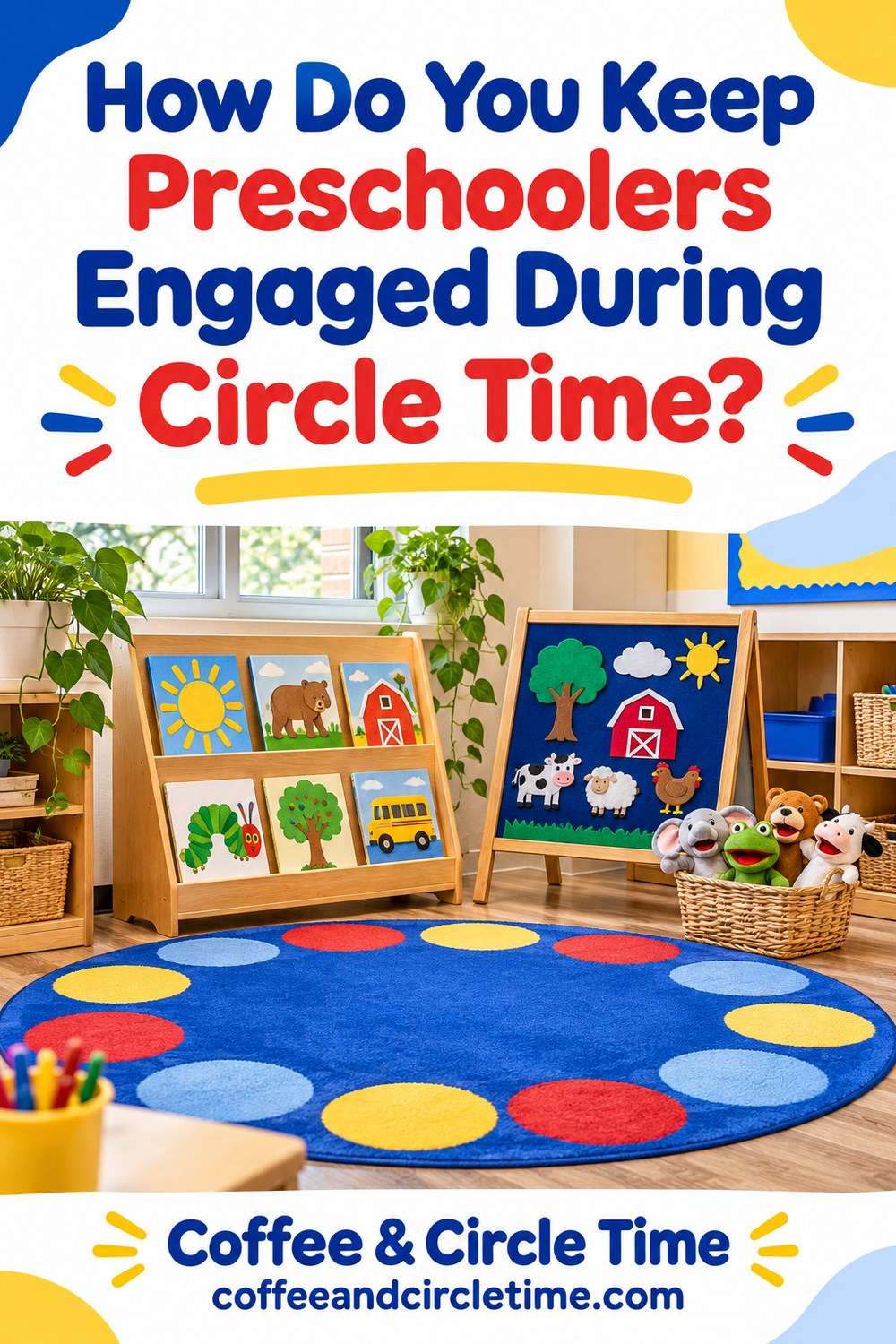
You can keep preschoolers engaged during circle time by giving them frequent ways to participate, choosing a short sequence with a clear purpose, and adjusting the plan when the group has had enough. Use songs, movement, objects, pictures, and brief conversation so children have more to do than sit and listen.
A successful circle time includes children in the experience instead of measuring how long they can remain still.
Hi, I’m Ms. Jenn, a preschool teacher with 20 years of experience. I currently teach in a two year old classroom and share practical ideas from everyday teacher life here at Coffee and Circle Time.
Start with what you want the group to experience together. A greeting, a shared story, or practicing a familiar song may be enough for one gathering.
You do not have to fit every calendar activity, classroom announcement, lesson, and discussion into the same sitting. Choose the pieces that belong together and save others for a more suitable moment.
When everyone needs to sit down, I sing, “I like the way [child’s name] is sitting.” I have found that noticing a child who is already sitting encourages other children to do the same.
I use it as a positive invitation to the group. Children who need a different seat or extra support can still take part in a way that works for them.
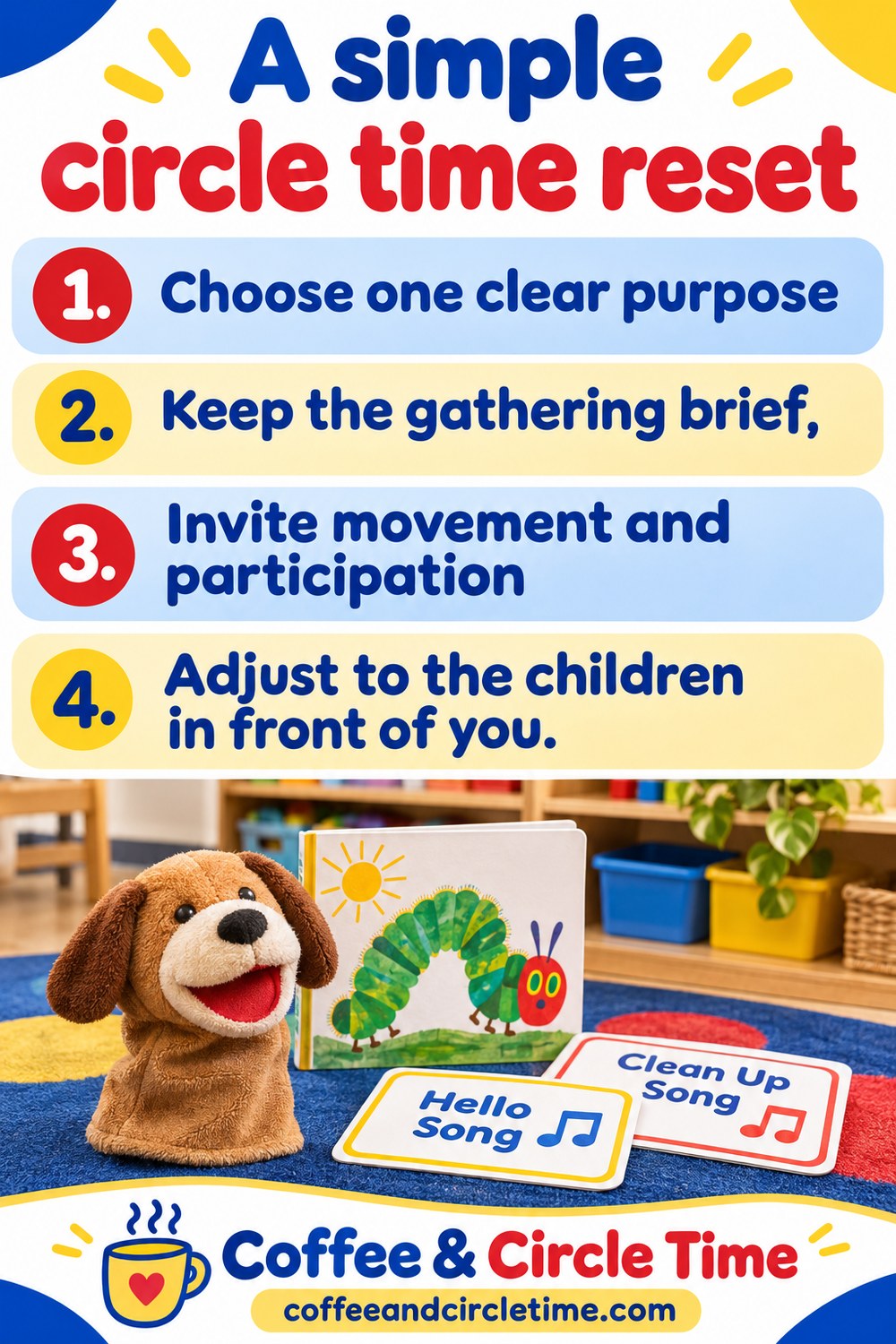
Give the gathering one main purpose
Ask yourself why you are bringing the whole group together. Is it to welcome everyone, enjoy a book, introduce something new, or prepare for a shared event?
That purpose helps you decide what to include. If the goal is a greeting and connection, a long sequence of adult questions may distract from it.
Write down the two or three parts you actually need. For example, you might plan a welcome song, a short story with participation, and a movement transition.
The plan can still include flexibility. You can repeat a song children enjoy or shorten a conversation that is not holding the group’s interest.
Avoid adding a task simply because it has always appeared on the circle time board. Consider whether it fits these children and this gathering.
A clear purpose makes it easier to recognize when circle time is complete.
Give every child a way to participate
Look for moments when only one child is doing something while everyone else waits. A long series of individual turns can leave most of the group without a role.
Instead, invite responses that several children can make together. They might point to a picture, show an action, join a repeated phrase, or choose between two movements.
You can still include individual contributions. Keep them connected to the shared activity rather than requiring every child to give a separate answer before anything else happens.
For example, one child could choose an animal and the group could move like it. Another child could select the next familiar song.
Offer ways to participate that do not depend entirely on speaking in front of everyone. Looking, gesturing, pointing, and using a familiar communication support can all belong in the experience.
Notice whether your question invites participation or mainly checks who already knows the answer. You can use observations and conversation without turning the gathering into a test.
Alternate listening with something children can do
Think about the sequence from a child’s position. How long do they spend listening before there is a reason to move, respond, look closely, or make a choice?
A song with actions can follow a short conversation. A repeated phrase can give children a role during a story.
Choose movement that fits the available space and the children’s needs. Some children may participate from a seated position or with a smaller movement.
Explain the action clearly and model it. “Reach up, then bring your hands back to your lap” is easier to follow than a long description of what comes next.
You do not need constant excitement. Quiet observation can also be meaningful when children have something interesting and accessible to notice.
Participation can change pace without making the whole gathering louder or more complicated.
Choose props that help children understand
Use an object, photograph, picture card, or other appropriate material when it adds meaning to the activity. A prop should help children follow the idea rather than compete for attention.
For example, a few pictures from a familiar story can support retelling. A classroom photograph can help explain a change in the daily routine.
Make sure children can see what you are showing. A tiny item held far away may create frustration rather than interest.
If you pass an object around, think about the waiting involved. You may want to explore it later in smaller groups so everyone has enough time.
Choose materials suitable for the children and supervise their use according to your program’s practices. A circle time prop is still a classroom material that needs thoughtful selection.
Prepare only what you can handle comfortably while watching the group. A large bag of unfamiliar objects can create more sorting than participation.
Keep the length responsive to the group
There is no single length that makes every preschool circle time successful. Look at the children, the purpose, the activity, and what happened immediately before the gathering.
A group arriving from active outdoor play may need a different opening from a group that has already spent time waiting. Adjust what you ask of them accordingly.
NAEYC’s developmentally appropriate practice guidance recommends keeping whole group periods within children’s attention limits and including other ways of learning. Its emphasis on flexibility supports reviewing the plan rather than insisting on a fixed performance.
You can explore NAEYC’s guidance on teaching to enhance children’s development and learning for the broader approach.
Watch for useful information. Are children participating when invited, able to see the materials, and following the shared activity?
If several children become disconnected at once, consider ending or changing the sequence. Repeating reminders to sit still may not address what the activity needs.
Change the arrangement when access is the problem
A child may appear uninterested when the book is difficult to see, the space is uncomfortable, or the instructions are hard to follow. Look at the setup before deciding the child is choosing not to participate.
Check where materials are held and whether everyone has a clear view. Move yourself or the object when that improves access.
Consider seating and personal space. A crowded gathering area can create difficulties that another reminder about listening will not solve.
Use classroom supports already appropriate for the child, and coordinate with the people responsible for any individualized plan. The aim is participation that fits the child’s needs.
If a different group size would help, save part of the activity for a smaller gathering. You may get more meaningful conversation when fewer children are waiting to speak.
An adjustment to the setting can be more useful than another correction directed at a child.
Use a clear ending and a planned transition
Tell children when the shared activity is coming to an end. A familiar closing phrase or song can make the sequence easier to recognize.
Explain what happens next before dismissing the group. Keep the instruction connected to the actual transition, such as returning materials or moving to an available area.
Avoid ending with a long wait while you prepare the next activity. Set up what you reasonably can before the gathering begins.
If children leave in smaller groups, give those still waiting something simple and appropriate to do. A short familiar action song may fit better than restarting a new lesson.
Coordinate supervision with any other adults involved. Everyone needs to know which children they are supporting during the change.
Review one part of the gathering afterward
Choose a specific question for your own reflection. Which part invited participation, where did waiting increase, and what would you change next time?
You might discover that children enjoyed the story but lost interest during a long sequence of individual questions. Keep the story and change the waiting.
You may also notice a favorite song that works well as a reliable opening. Familiarity can have a useful place beside new experiences.
Write down one adjustment rather than rebuilding the whole routine after a difficult day. A shorter sequence or clearer view of the book may be enough to test.
Circle time can be a brief, meaningful connection within a day that includes many other ways to learn.
Begin with a purpose, invite children into it, and let their participation guide what you do next.

Leave a Reply