
When a preschooler does not want to join circle time, start by finding out what is making the experience difficult and offering a manageable way to participate. A child may be comfortable listening nearby, joining one song, or sitting beside a trusted adult before becoming ready for more.
The first goal is to help the child feel included and supported while you learn what they need. Turning circle time into a public contest over sitting down can make it harder to understand the original problem.
Hi, I’m Ms. Jenn, a preschool teacher with 20 years of experience. I currently teach in a two year old classroom and share practical ideas from everyday teacher life here at Coffee and Circle Time.
Your response should fit the child, the classroom, and your program’s procedures. There is no single script that explains every refusal, and one difficult morning does not tell you everything about a child’s relationship with group activities.
When a child is overwhelmed, redirecting them is one of the approaches I use in my classroom. I pay attention to the child rather than treating every difficult moment as the same problem.
If a child is missing their parents, I may help them focus on our classroom family tree. I use that example for missing home rather than assume every child who hesitates at circle time needs the same response.
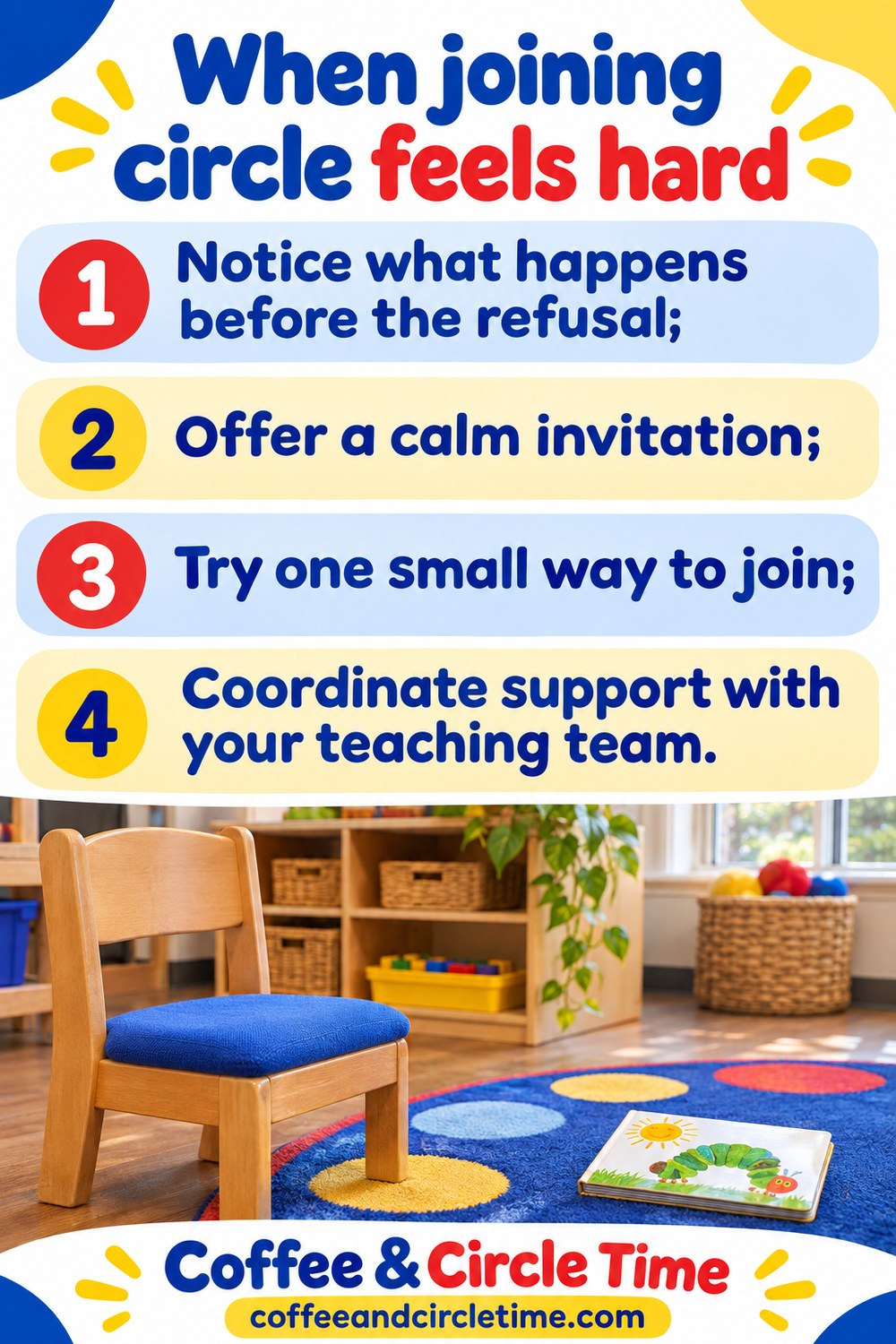
Look at what happens before the refusal
Notice when the child begins pulling away. They may enjoy the opening song but leave when a long discussion starts, or become upset before the group has gathered at all.
Think about the transition into circle time. A child who has just started building something important may need a clearer ending and a way to return to that work later.
Look at the setting as well as the child’s response. Noise, crowding, bright light, an uncomfortable seat, or uncertainty about what will happen can all be worth checking.
Write down concrete observations rather than labels. “Stayed near the bookshelf during the story and joined the movement song” gives you more useful information than “would not cooperate.”
Offer a calm invitation
In my classroom, I redirect children back to circle time by inviting them to come sit down and making what we are doing seem fun and interesting.
I also have a pointer that children get to use toward the end of circle time if they sit nicely during the activity.
Approach the child with a short, clear invitation. You might say, “We are starting our hello song, and there is space beside me.”
Give the child a moment to respond before repeating yourself. A stream of reminders can add pressure without making the next step easier to understand.
Keep your voice and expression steady. You can hold a classroom expectation while still showing that you are available to help.
If the child is upset, address that immediate need first. A long explanation about why circle time matters is unlikely to help while a child is struggling to settle.
Make joining a smaller step
Instead of asking for the entire group experience at once, offer one clear starting point. The child might join the greeting, choose a song card, or listen to the first page of the book.
Tell them what that step involves and what comes next. “You can help us sing the first song, then we will check in” is more concrete than “Just try to be good.”
Choose a starting point that is possible within your actual classroom routine. Do not promise an option that the available staff cannot support or supervise.
A small successful experience can give you more to build on than repeated demands for full participation. Notice whether the child becomes more comfortable when the expectation is clear and brief.
Consider a different place to sit
Some children may be more comfortable at the edge of the group, in a chair, or beside a teacher. Follow the child’s support plan and your program’s guidance when choosing an arrangement.
Make sure the alternative place remains part of the group rather than feeling like a punishment seat. The child should still be able to see, hear, and participate in the experience.
Avoid insisting that every child sit in exactly the same position. The important question is whether the child can engage safely and comfortably, with respect for the people nearby.
Watch what changes when you adjust the seating. A practical improvement is more useful than assuming you already know why the child wanted to stay away.
Give listening more than one visible form
A child may follow a story without answering every question or looking directly at the teacher. Notice gestures, quiet comments, repeated words, and connections they make afterward.
Offer simple ways to respond together, such as pointing to a picture or making a movement. This gives participation a clear shape without requiring every child to speak in front of the group.
Keep choices optional when the particular action is not essential. A child can belong to the song even if they are watching before they begin making the motions.
At the same time, keep expectations about safety and other children’s space clear. Different ways of participating still need to work within a supervised classroom.
Check whether circle time is asking too much
Look at the length and structure of the activity. A long sequence of calendar questions, waiting turns, and adult talk may need adjusting for the whole group.
Choose one useful purpose for the gathering. A welcoming song and a short story can make a coherent experience without adding several unrelated tasks.
Put active participation early rather than saving it as a reward for sitting through everything else. Invite the children to notice, move, predict, or contribute while the activity is happening.
If several children are struggling in the same way, consider changing the experience itself. The pattern may be telling you something about the schedule or format, rather than about one child’s willingness.
Offer a supervised alternative when appropriate
Some classrooms can support a nearby quiet activity while a child listens or takes a break. Other rooms need a different arrangement because of staffing, space, or individual support needs.
Choose the option with your teaching team and within program procedures. An alternative should not place a child outside adult awareness or leave another part of the room without enough support.
Make the expectation simple and consistent. Explain where the child can be, what they can use, and how they can rejoin.
Avoid presenting the alternative as something shameful. It is a way to support participation and regulation while you keep learning about what works.
Coordinate with the other teacher
Agree on who will lead the group and who can support an individual child. A quick plan can prevent both teachers from giving different directions at the same time.
Share the actual words and options you are using. Consistency is easier when “offer a place beside you” means the same thing to both adults.
Check in afterward about what helped. Maybe the child joined readily with a picture cue, or maybe the busy transition remained difficult despite a shorter gathering.
Discuss disagreements away from the children. Circle time should not become the setting for adults to debate how a particular child ought to behave.
Talk with families without assigning blame
If the difficulty continues, share specific observations with the family according to your program’s communication procedures. Ask what they notice about group experiences, transitions, or the child’s current interests.
You might say, “She listens from the book area during our first song and comes over when we use the puppets.” This opens a more useful conversation than describing her as a child who refuses everything.
Do not assume the family must be causing the problem or can fix it overnight. Their observations can add context while the teaching team continues adjusting the classroom experience.
If concerns persist or the child needs more support, involve the appropriate people in your program. Follow existing plans and procedures rather than trying to diagnose a child from circle time behavior.
Notice progress in ordinary moments
Progress may look like standing closer, staying for one song, choosing a book, or returning after a brief break. These observations can help you choose the next manageable step.
Acknowledge the child’s contribution in a natural way. “You found the picture we were talking about” connects your response to what the child actually did.
Avoid turning participation into a public comparison with classmates. The point is to build comfort and connection, not to announce who is easiest to manage.
A preschooler who hesitates at circle time still belongs to the classroom community. Calm invitations, thoughtful adjustments, and a consistent team response can make that belonging easier to experience.
Start with what you can observe, offer one accessible way to join, and review what happens. You can keep the group moving while giving an individual child support that is practical, respectful, and specific.

Leave a Reply